with the occasional rant about tin openers...
Showing posts with label homebrew. Show all posts

Wednesday, August 9, 2017

Best Bitter, for cask.


Having brewed nothing at home for nearly a year, I’m making up for it now. The same can be said for this blog. Nothing new for years, and now I’ve a backlog of posts. Not because I’ve got more to say, necessarily, but I’ve finally got the hang of separating the content. So, to tease, the next couple of posts will include:

  • Toys for a Tenner: All the best toys for really keen homebrewers
  • Great Gruit: Brewing with Kviek and some not-hops
  • In good nick: Real ale, and how to get beer on the floor and in your face
  • Get pally at your local: Building an awesome bar from pallets

Onto the bitter. The recipe is similar to the last, because it was really very good. The changes include swapping out some crystal malt for Munich and Aromatic, simply because I wanted to try the Munich, and I was sent more Aromatic than I needed, and less crystal because I wasn’t. In they go.

This is a single hopped beer (not like that Double Hopped madness from Diageo, Hophouse 13), in that it is bittered, flavoured and aromad by Pilgrim. I’m nowhere near the end of the British hop list yet, so I’ve no interest in American or NZ hops when there are still so many varieties to try nearer to home. Pilgrim was described as "deeply fruity, lemon/grapefruit aroma with flavour characteristics including verdant, berries and pears. As a bittering hop it provides a refreshing, full-bodied and rounded bitterness" by The Homebrew Company, and they recommend its trial, so having enjoyed it in the first batch, I’ve stretched to another packet of pellets for bittering. I need to use some leaf hops to help filter out the trub etc, so the last additions will be leaf, totalling about 70 grams (This is a double batch, aiming for 44 litres in the fermenter). 70g won’t sound like much to many of you, I’m sure, but this is a session beer, remember. Drinky drinky, not sippy sippy.

The yeast is a reconditioned Fuller’s bottle, and it’s being stirred right up until pitching. This is its second run for me, and seems in good condition, so I’m happy to pitch later this evening. It’ll be a two litre starter, but I’ve no idea what that means in terms of yeast cell growth, as the starting quantity was one metric dollop, and it’s viability unknown.
I think the Fuller’s strain is WLP002, English Ale or something, should you want to pay €8 for it.
The recipe:
Minch pale (4-6srm) 5.8 kg
Munich malt (  ) 500g
Crystal 40 (80), 300g
Aromatic malt 200g
Torrefied wheat 500g
Water: down to 35ppm alkalinity, and added 10g CaSO4, 4g CaCl. 22.5l, should give roughly 3:1 litres:kg. God only knows what the Sulphate : Chloride ratio will end up, but going from experience it should be roughly 2:1, with about 200 – 300 ppm sulphate, and half of that in Chloride. That will leave plenty of Calcium for the yeast. Treated enough water to liquor back at the end.


Temperature settled at 65oC, so should get the FG down to 1010.
The grist yielded 44 litres of 1046, with plenty more sugars left to extract (sparge stopped at 1020).
Boil:
Pilgrim (pellet) 10.3%aa, 42g
Pilgrim (leaf) 10.4%aa, 35g (+ ¼ tablet protafloc)
Pilgrim (leaf) 10.4%aa, 25g

1 small handful added to cask. Book says so.
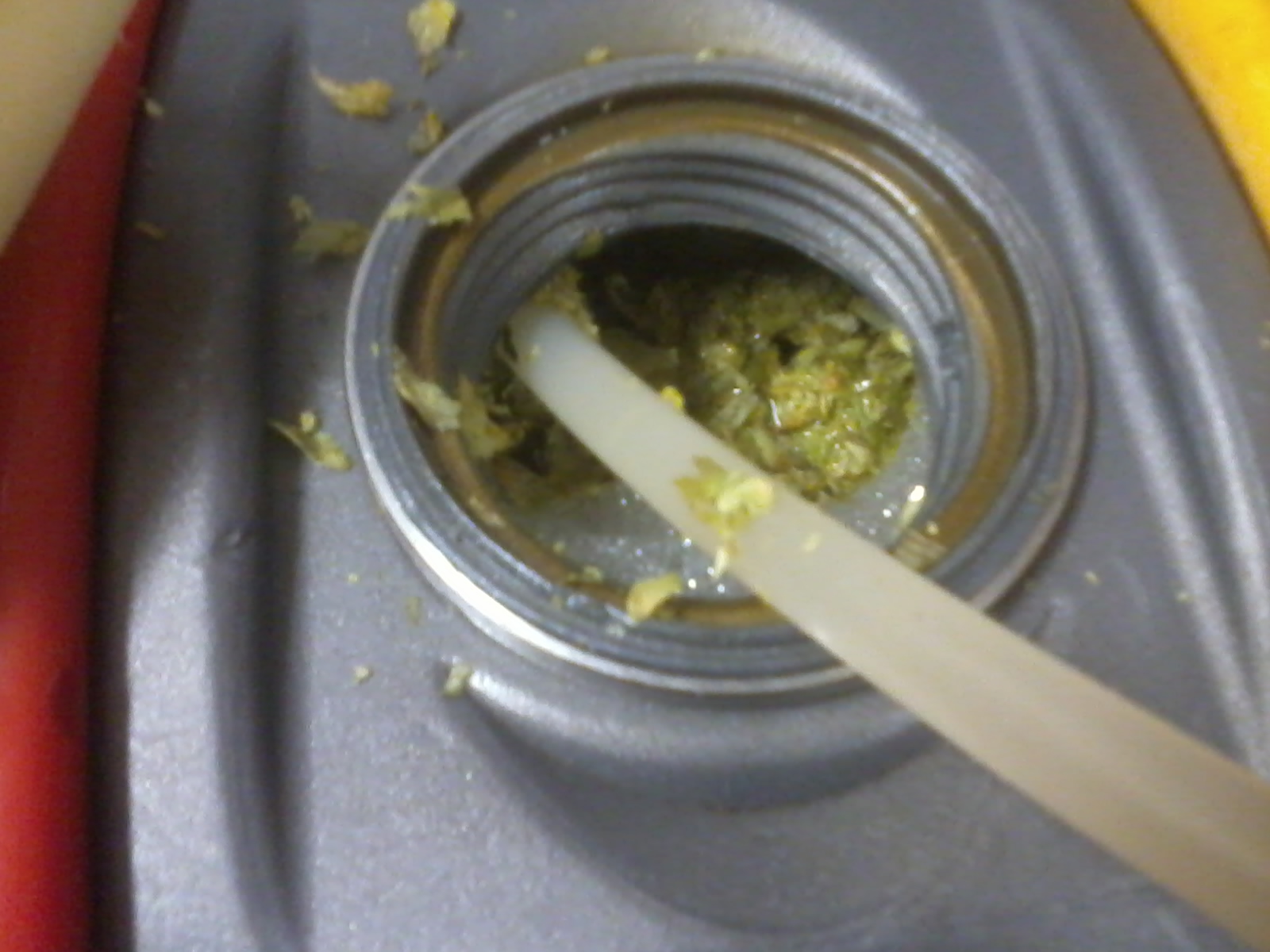
The wort is an excellent dark copper colour, which pleases me. This was acheived by using a little chocolate malt the last time, but I think I tasted it in the form of a little dryness, so to have this happen accidentally from the Munich etc is a pleasant, though not entirely unexpected surprise.
Why am I bothered by the colour? The beer is to be served at a wedding, alongside a locally brewed golden ale, and a locally brewed stout. It’s nice to brew a beer that’s a different colour, and nobody wants to drink a red ale all day: I speak from experience.

Result:
So, about all I can remember is that it was delicious, very popular, was lighter (colour) than I expected, and needed about another week for some of the hop roughness to smooth out. However, an excellent beer, of which many a pint was had. This was in contention with a locally brewed golden ale and a stout, and they all pretty much emptied at the same moment, so I’m pleased with the result.
Not so pleased, however, that I won’t be adding back some more crystal malt the next time!

Thursday, March 30, 2017

Homebrewed is Best

It’s nearly April, not that that means anything by itself, but I’ve wanted to brew a bitter for a while now. I reread Pete Brown’s ‘ManWalks Into a Pub’, an excellent book on the evolution of the British public house, and frankly that made me very thirsty. I’ve also been reading TheDoghouse, a pub-based periodical from Ludlow, who also run a micropub from the same office. Fancied a pint.
But no, I’ve wanted to brew a bitter since before then, too. I meant to brew one for the Belfast CAMRA ale festival in November, but missed the deadline by some months. On paper I’d been messing around with a recipe (mainly hop and yeast selection, and a standard malt bill), and so as far back as probably July I’ve been thinking about Bitter.

Bitter is my favourite beer style of all, and it just doesn’t seem to exist in great quantities in Ireland, apart from my occasional trip to Wetherspoons in Derry, where it is served on handpull. It’s time to brew one for the house, for my own set of beer pumps.
 
The recipe is fairly standard, except that I’ve used a lot more wheat than usual, as I want to really nail the head retention this time. I’m also watching the calcium content for the same reason. The brewing guidelines I’m using today come from Nigel Sadler’s book ‘Notes on Craft AleBrewing’. It’s and excellent reference book, full of calculations and science, and has helped fill in a few gaps that other books have missed. The ‘rules’ that I’m specifically adhereing to are the water guidelines, hop rates and method, yeast pitching rates and so on. If you’ve read the Brewing Elements series, then I can recommend this book too, though it’s more use as a postscript than an introduction.

The yeast comes from the dregs of a bottle of Fuller’s IPA. Yeast culturing is something I haven’t had a proper go at yet, normally opting for sachets of dry yeast (I see nothing wrong with dry yeast, except for the lack of variety, which Mangrove Jacks have gone some way towards rectifying) or the slightly more expensive liquid options. WhiteLabs are fantastic; their standard range, plus the Platinum seasonals, strange new yeasts and bacteria thanks to Yeast Bay, and now even rarer yeasts WhiteLabs ‘the Vault’, it’s a great time to be a homebrewer. However, in the microbrewery, it’s nearly ten times as expensive (or thereabouts, nobody will actually give me a proper price) to buy liquid as dry, for the quantity I need, so I wanted to do a few trials of the stirplate first. I couldn’t be happier with my first effort! The idea is to buy an €8 vial of WhiteLabs and culture it up to the 750g yeast that I need for a brew. This will open up a world of yeast for use in the brewery, without the increased cost.
Just like cats, homebrewers know the warmest places in the house.
Instructions for making a stirplate and starter are readily available online, and I made mine for nothing, using stuff I had lying about the house. One of the options to consider is one magnet or two. That decision was made for me by misplacing one of the pair. The magnet sits in the centre of the computer fan, and works fine. I expect both ways have their merits. Practice using your stirplate with a glass of water first, to see what stirbar size and speed etc will do. I bought a packet of stirbars in various sizes from eBay, which gives me plenty of options, from the tictac sized stirbar for small starters, through liquorice torpedo sized, onto half-a-fudge, which should works in a demijohn.

Just FYI, then, I added 200ml of 1.020 unhopped wort to the dregs of a bottle of Fuller’s IPA, stirred that, increased that to 500ml at 1.030, then one more step to 2 litres of 1.040.


The recipe itself is standard enough:
Pale, 3240g (81%)
Crystal 80, 320g (8%)
Wheat malt, 400g (10%)
Chocolate Malt, 40g (1%) for colour adjustment – I’ve been drinking golden beers for ages


Mashed at 67oc, with water adjusted to
<40ppm alkalinity,
150ppm Chloride,
300ppm Sulphate, and
100 - 200ppm Calcium.
Spargewater the same.

Copper volume, 24litres at 1038, should give me a 20 litre ferment at 1040.
Northdown 6% to bitter, to 30IBU (29g pellets)
Pilgrim 10% at 15 minutes, 15 grams, and ten more at flameout. Some protafloc at 15, too.

Yeast, Fuller’s IPA (I hope it’s not a lager strain used for bottle conditioning, now I’ve gone to all that effort!). Pitched the fresh slurry at 22oc, god knows how much or how little, but


Tasting notes to come.

Monday, December 7, 2015

Carbon Footprint of your Home Brew

I've actually worked this out in one of my notebooks. It turned out to be a pretty hefty figure. I've only worked it out for the sugars consumed in the beer, for example, a five gallon batch of 1040 OG beer, fermented to 1011, will produce about 1kgof carbon dioxide. I agree, it sounds like a lot, but that's science for you.

http://www.guardian.co.uk/environment/green-living-blog/2010/jun/04/carbon-footprint-beer

Weep as you add in the airmiles of your beautiful American hops...

Cascade is grown in the UK, if you can get it, though it's mostly under contract. Still a lot of miles for your beer. Buying, growing, picking and using local is the only answer. To look about growing your own hops, here's a handy link!

www.gyohops.blogspot.ie

 If I can do it in northernmost Ireland...

Thursday, April 3, 2014

Hop Plant Bull Shoots

It's the time of year when hops start having big ideas again. Two sunny days and they're OFF!

You may have heard about 'trimming the first gamey shoots', or 'removing the bull shoots' and not been clear which they are. Well, here's a photo.

The bull shoot is about 6 inches long where the others are barely an inch. In this photo, of a second year First Gold, there are two bullshoots that are both over half a foot. After this photograph was taken I cut them back to ground level in order to let the others grow. Eventually I will select only two or three of these to grow on, and snip back the rest.

Bull shoots are no good as the internodal distance, or gaps between the leaves are quite large. Seeing as the cones are produced here, in order to get a higher yield you need more nodes, which you get in the later shoots.

For now though, that is all you need to do with the hops. The second set of shoots will grow at a steadier pace, so you've nothing more to do this week.

Next job: Putting the bines to string.
For more information on hop growing, visit:
www.gyohops.blogspot.ie
This picture was taken on 3rd April.

Wednesday, December 4, 2013

Brewing Britain - Andy Hamilton

Congratulations to author and forager Andy Hamilton, of Booze for Free fame, on the release of his latest book, Brewing Britain. 

http://www.amazon.co.uk/gp/product/0593072405/ref=as_li_ss_tl?ie=UTF8&camp=1634&creative=19450&creativeASIN=0593072405&linkCode=as2&tag=selfsufficien-21
Available in all good book stores, and Amazon.
Brewing Britain takes you on a trip through brewing history, buying and growing almost all of the ingredients, malting barley, and drying hops, and plenty more besides.

But most of this is preamble to the main point of the book: brewing beers of the styles commonly found in Britain. Milds and Bitters, IPAs, Stouts, Porters, Saisons (!?) and the odd lager. These come with style notes, common ingredients, commercial examples with tasting notes and a series of tried and tested recipes for making your own classic example.

To finish, Brewing Britain indexes a whole flight of beer festivals, all year round, for you to impart your hard won knowledge/try out your new skills.

Oh, and I've got a beer in it!!

The book would suit anyone with an interest in beer: from kit and all-grain brewer to Beer Sommelier and Real Ale Twat*. And it is coming up to Christmas…

*Viz. That is, Viz, not viz.


Monday, December 2, 2013

Tiger Beer clone, all grain.

And a bit about mash pH lower down.

Most visits to this blog come from people searching for tiger beer clones. I’ve referenced it a couple of times, including one previous attempt at the beer, which worked really well. It was mooched from the Dave Line ‘Brew beers like those you buy’ book, with a change here or there (not necessarily because I know what I’m doing, or anything). The first attempt worked quite well, the second was infected, and for Ms Homebrew, the third attempt will be ready in the new year.

This is a 'lite' lager beer, of the kind found in Asia and thereabouts.

3kg Lager Malt (Pilsner malt)
500g flaked rice
300g Carapils or similar
200g Acid malt
Recommended, 200-500g of rice husks or oat husks, as the mash Will be slow to run off.

Mashed in for a rest around 55oc for 30 mins, followed by the main rest at 66oc for one hour, in 10 litres of soft water.

Boil:
Hallertaur Helsbrucker (2.8%): 25g, 11 IBU
Dana (Super Styrian)    (10.8%): 7g, 11 IBU

Flavour, Hall. Hersb., 10g @ 15 mins with a dose of Irish Moss
Aroma, Tettnang (German), 10g @ 0 mins.

Cool and strain.

This should yield 20 - 22 litres at 1038, which can be fermented with Brewferm Lager yeast, though this time I'm using a sachet of Saflager 34/70 sprinkled into the wort. If you can ferment it at the proper temperatures, do so, otherwise do as you can. Warm is NOT your friend here, though.

A diacetyl rest (14oc about 3/4 of the way through fermentation) is advisable.

Tasting notes to follow.

Rice & Carapils:

It may seem counterintuitive to use rice flakes to lower the beer's body, and carapils to boost it, but what I'm trying to achieve is a beer with very little malt flavour, but some body. Using rice alone will reduce taste and body, but I can add some body back in with carapils (dextrin malts, etc), and as carapils is also tasteless in the beer, it won't affect the malt flavour balance. In addition, I will use relatively high carbonation to give the impression of body.

Mash pH:

Most lagers benefit from a little acid malt to help with mash ph, and in spite of having soft water piped into the house I do have to use it in all my brews to help the ph level. I’m quite happy to do this alongside Burton liquor treatments in my Bitters.

An alternative is to use an acid rest into your mash schedule. It’s at about 35oc (up to 40oc), and should last about 3 hours (or overnight). The acid rest allows the lactobacillus bacteria that are all over your barley malt to flourish for a short period of time, which tends to acidify the liquor. The bacteria don’t make it into the finished beer, though.

Acid malt, though, has already been through this step. Every 1% added to the grist decreases the mash pH (that is, acidifies) by 0.1; so if your tap water is fairly soft, like ours at pH 6.5, to get it at the perfect pH for efficient enzymatic activity which is below 5.5 I’ve added it at 7.5% of the grist (not recommended over 10%).

Acid malt is otherwise the same as your pale malt, so decrease the amount of pale malt used appropriately, which will keep your grist ratios in check. Weyermanns' acid malt is from two row barley, so will not add haze, like you might expect from 6row barley.

Tasting Notes:
The beer is ready, having been lagered at cellar temperature. Hardly lagering at all! After about 3 weeks in the bottle it's nearly perfectly carbonated. 

Aroma: Moderate Ethyl Hexanoate (apple-y), some floral hops, and a moderate grainy aroma.
Appearance: Straw, ever so slight haze, long lasting rocky white head, with a nice beading carbonation.
Flavour: Typically low for a light beer, can taste a little grainy, and a little apple-y. 
Mouthfeel: Nearly a very light body, with a brisk carbonation (though missing the carbonic bite), and some residual sweetness. Very light bitterness.
Overall Impressions: Some tiny modifications to the recipe and I need to pay more attention to ester production (temperature and pitching rates). Otherwise very good.

There is a little residual sweetness, it's medium-light bodied, with a medium high carbonation.

I continued to drink this beer over the course of another month, and the flavour improved dramatically in that time. The yeast cleared up the aetaldehyde (in both this and a Munich Helles I reused it in) and left a delicious and refreshing beer. This beer certainly needed the time to improve and all of a sudden I've gone and run out!

This beer won a silver medal at the National Homebrew Competition 2014, run by www.nationalhomebrewclub.com

Tuesday, November 6, 2012

Brewlab Education

And it's back to college for a few days!

I've been booked on the course since June, but I never thought it'd come around. But now I'm here, I can't believe I'm already halfway through! I've just finished the second day of the 3 day plus one Startup Brewery course at Brewlab Ltd, and it's basically sorted out all of my problems, from mash efficiency to those funny off-aromas, without even bothering to try one of my beers!

Firstly, the course took twenty of us (some home brewers, some not), through the brewing process from start to finish, and funny enough, they started with the brewing liquor, or water-what-you-make-beer-with, starting with the treatments in order to keep the beer in character and style with the original, and also in order to increase the mash efficiency, by adjusting the pH of the liquor. So that's the first thing I'll need, some litmus paper.

Then Arthur took us through the recipe compilation, using the ol scale, which measure's the malts potential extract, and will more than likely lead to much more accurate predictions of O.G., or the amount of fermentable sugar I can expect in my wort (pronounced wert, apparently, even in a thick Geordie accent). Out with Imperial, in with Metric. Sigh.

Arthur also casually pointed out that my DMS problem (smells like teen bedroom) comes from not chilling the wort quickly enough (or at all, in my case, as I usually let it cool down over a period of hours). Unpicking my brewing experience with one casual casual question: how do you cool down your wort?

The rest, all equally important, but numerous, will all be addressed soon. Some will be addressed at relatively little expense, some will likely cost more. Dr Thomas advocated getting a little more familiar, if not downright voyerstic, with yeast. Buy a microscope. I think Santa will be busy picking through 400x magnification Haemotologists microscopes in the Argos catalogue this month!

So, two more days to go, so much to learn, and so little time. You can see some gaps in your knowledge fill up, while watching others burst open, as you realise how much there is yet to learn! Early to bed tonight then... well, I'll just 'sample' this one more pint!

Tuesday, December 20, 2011

'Tis the season...

Needing an extra empty pop bottle is a weak excuse for drinking homebrew before lunch. In the end I didn’t actually need the extra bottle, but the lengths I’d go to to secure one are as yet unplumbed.


The reason I needed another bottle is I’ve finally gotten around to bottling some cider. It’s been under fermentation lock for about as long as I can remember. Now it’s split between three 1 litre bottles, primed and awaiting spring. I’ve only a few more bottles of the Mmmild to give away, and then that’s the homebrewing done for another year (though there are still bags of empties and a keg needs washing!). If Santa gets me some ‘AAA’ batteries for Christmas I’ll be making some more booze in January (thermometer and beard-trimming-machine both take ‘triple A’s, so no mashing or shaving has been done for some time).

I’ll be looking forward to making some more lagers while the weather’s cold, which will be the perfect refreshing drink for our guaranteed hot Irish summer, and while I’m home over the festive season I hope to make a homebrew demo video. This will be a short, introductory video aimed at people who got their first homebrew kit for Christmas, and want to get cracking right away!

So, to end 2011, I’m happy to look back on a progressive year of brewing, from a tin in March, extract in May, and making the leap into almost completely all grain by July! The beers have been getting better and better, I’m making less and less mess, and I’m getting a whole batch of all-grain done in less that 12 hours! And that’s all true except for the less mess bit.

So, I hope you’ll check back for the video in January, but until then, Merry Christmas, and a happy new year. And remember: Homebrew isn’t just for Christmas, it’s a way of life.

Monday, September 12, 2011

Calculating IBU & Copper Hop needs!

It’s not something I lose sleep over, seeing as my scales aren’t pinpoint accurate anyway, but I’ve noticed in my homebrew reading that there isn’t a suitable calculation for getting IBUs or ounce weights for British gallons. Papazian has a nice one for American homebrewers using grams, and even goes as far as to suggest an equivalent for British measures, but in spite of the use of ounces, which weigh the same in the US and the UK, the equation still figures in US gallons, which, as I’ve already said somewhere, is a bit of a wussy gallon. So, here is an adapted equation I’ve been working on for a couple of hours.

Firstly, you can either use the original Papazian sum, which is: and then correct it for UK gallons by dividing the answer by 19 (the number of litres in 5 US gallons - 5 gallons being a typical batch size) and multiplying that by 22.5 (the number of litres in 5 UK gallons), or by multiplying the answer by 1.1842. Those will give you an answer in ounces, and they shouldn’t be miles out.

Or you could use my own simpler contribution to Imperial homebrewing, by using the “Evans UK factor”, or the EKs Factor!

The Eks Factor

The Eks Factor is a simple number that you can use within the above equation that will give you an answer for your common or garden UK gallon brew. So instead of 1.34, use the number 1.587, and thus the equation becomes:
So, for a 5 UK gallon brew, with an IBU of 50, hop utilisation of 30%, an Alpha Acid content of 6% and the Eks Factor, 1.587, the sum goes as follows:
To get an accurate answer you do need to use the factor to 3 decimal places, but then, if like me your scales don’t go much lower than an ounce, I’d recommend, in Papazian’s own words, “don’t worry, have a homebrew”.

I’ve looked through about half of the books on homebrewing available, and the older UK books tend to only use AAU and HBUs in the calculations, which is too general for me. The American books, for example Papazian’s The Complete Joy... doesn’t account for the larger UK gallon, and the exquisitely detailed Designing Great Beers by Ray Daniels has something that’s far too complicated for me to get a straight answer out of – my head just can’t get round it! Brew Classic European Beers At Home has an equation in grams that can be converted into ounces if needed, by dividing the gram answer by 28.35 (the number of grams in an ounce), although that answer will be about 0.002 oz out!

Anyway, to sum up, for a very easy equation for anyone brewing in macho-gallons, use the following: I’m no mathematician, and given that I’m not even sure my hop utilisation IS 30%, it really is just splitting hairs. In order to accurately assess your hop needs or IBUs, colour of your beer etc. read Ray Daniels’ Designing Great Beers. But if you’re merely staggering drunkenly towards your perfect pint, my Eks Factor will suit you nicely! Good luck, and happy nit-picking.

Wednesday, July 13, 2011

Tasting beer and tastes in beer

Never let it be said that I do anything in halves. There are a lot of things I don’t bother to do at all, but anything I do do gets done good and proper.

So, not really knowing all that much about beer, except that I like it, I’ve started trying a number of different bottled ales that can be found in our supermarkets and bars. We’re not flush up here, but fortunately you can get a bottle of ale for less than £2, which alongside some olives for the missus, and cat food for the cat, I see a bottle of beer in the weekly as a reasonable luxury (yeah, I know, "whatever gets you through the day"). I’ve recently tried Timothy Tailor’s Bitter (Engerland), Whitewater’s Red Ale (Belfast), a Downpatrick Bitter, Goose Island IPA (Chicago), two pints of Bass, and, from Eniskillen, a secret bottle of wheat beer, a gift from a friend with the surprising instruction “add blackcurrant”. After all that, what I don’t know about a malt profile ain’t worth knowing.

So there I am, trying beer, wondering what exactly goes into these that make them so darned tasty, if it isn’t a lock of MSG? Why exactly is it that our everyday, mass-produced beer tastes so bland in comparison?

I’ve begun to realise the importance of yeast in the whole thing. Not only does it affect the overall sweetness, as you’d imagine, but all the fruity stuff comes from it if it’s too warm, and so on. So how much of an effect can yeast have?

Two questions, and no answers, so far. The yeast thing… well, I’ve started some ginger beer with champagne yeast, and so far the yeast is all I can taste. Since, I’ve made Smithish with both toasted and roasted barley, and I’m getting the feel for different hops, as well as quantities and styles of beer. It’s all part of the brewing learning curve, but it’s nice to improve recipes when you know what goes into them in the first place!

But I digress. It’s not my beer on the shelves. It’s the likes of Goose Island IPA, which wasn’t selling in the bar*, and I don’t think it’s for want of knowing about it, as in the bar they stock a wide variety of beers from around the world, which are advertised in a little ‘menu’. And, no, before you ask, it’s NOT a Wetherspoons. Similarly, the beer from Downpatrick doesn’t seem to fly off the shelves in a bar full of ‘locals’. Granted, not local to DP, but local Irishmen nonetheless. I mean, Carlsberg! Seriously? Won't they even try Harp?

I was chatting to a fellow bandmate at that bar recently, during the ‘refreshment’ break of a recent gig. I noticed, quite by chance, a leaflet for a bottled bitter from a local brewery. I ordered one. The guitarist apparently loves ale, and drinks nothing else when he’s over in Engerland (drinks bottled Heineken here), and he ordered one. That was three bottles sold that night, because I happened to go leafing through the leaflets. Elsewhere I’ve noticed Bass on tap, and I’ve allowed myself the usual look around to see if anyone else was drinking it, which they weren’t, and ordered one anyway. I’m very funny about the first pint out of a tap…

I know places like “Rhymes with Al Fresco” and “sounds like Painsburys” probably stock ‘local’ beer nationwide, so I can’t really include them when discussing local, but there are places trying to stock local booze, when it’s available, and it’s a pity it’s not flying off the shelves. I’m keen to try local booze when I see it, but it’s also hard to find. Hilden brewers had a tent at a recent festival I went to, and I was fine with paying £3.50 a pint once, but after that, I was happy enough with warm can of… I forget… something cheaper anyway. You can’t always afford to be discerning!

So there’s definitely an ale profile over here in Ireland, but it’s not mainstream yet.

* When they knocked the price down by half, I felt sorry for them, which is why, between the three of us, we drank the lot. Not in an evening, of course; over two.